Friday, May 13, 2016

TRUST and FAITH: On Breaching the Barrier


"How could you, a mathematician, a man devoted to reason and logical proof....how could you believe that extraterrestrials are sending you messages? How could you believe that you are being recruited by aliens from outer space to save this world? How could you......?
.........................
 " Because" Nash  said slowly in his soft  reasonable, southern  drawl as if talking to himself, "the ideas I had about supernatural beings came to me the same way that mathematical ideas did. So I took them seriously." 

That was  from A Beautiful Mind : a biography of the  Nobel laureate and mathematical genius John Forbes Nash Jr. by Sylvia Nasar.


Almost half a century earlier Srinivasan Ramanujan had put it  slightly differently  "An equation for me has no meaning unless it expresses a thought of God". He was  certain that   it was goddess Namagiri, to whom he owed his mathematical gifts. Namagiri would write the equations on his tongue, Namagiri  would bestow mathematical insights in his dreams.  (The Man who knew Infinity  a   biography of Srinivasan Ramanujan by  Robert Kanigel 


Their respective colleagues   would state categorically that it was as if  Ramanujan and Nash knew the final answers before they even saw the problem. How do such brilliant  minds work?  Is it intuition?  The Oxford dictionary defines intuition as immediate apprehension or insight  without reasoning. 

Scientists are forever  curious to know.  Google's   AlphaGO , an  algorithm   programmed to play the board game GO, is the latest attempt to mimic this elusive human trait.   Located on networked computers (technical term distributed computing) the AlphaGO algorithm enables  
A GO game in progress(courtesy en:wikipedia)
Played with white and black chips, it is basically  a "surround and eliminate"  game
not only programmed moves but also  intuitive decisions, its creators claim.  With a
 computing power amounting to 1202 CPUs and 172 GPUs,   AlphaGO  demonstrated its capability  when it won 4-1  against the world champion Lee Sedol, recently.  

Tailpiece:
"Proof and Verification"  are the mainstays of Science.  In a recent editorial Nature cautions: Intuitive machines will need more than trust; they will demand Faith. 

A Beautiful Mind, biography of the Nobel laureate John Forbes Nash Jr. by  Sylvia Nasar  was made into a film in 2001 with the same title.    "The Man who knew Infinity"  a film based on Kanigel's book  has just been released. 

References:
1. The man who knew Infinity : Robert Kanigel,  Scriber 1991;Abacus 1999
2. A Beautiful Mind : Sylvia Nasar, Faber& Faber 1998
3. A Mathematician's Apology : G.H. Hardy , Cambridge University Press, 1967
4. AlphaGO 
4. How Google's AlphaGO Beat Lee Sedol
5. In two moves AlphaGO and Lee Sedol Redefined the future
5. Digital Intuition Nature, 529, 437 (28 January 2016)


Thursday, April 14, 2016

On being environmentally conscious


Biologist and conservationist Edward O Wilson strongly feels that half of earth's surface must be set aside just for Mother Nature.  Its feasibility is debatable, but then we can't close our eyes to the hard facts that  a variety of human activities continuously pollute air and water  two precious components for the sustenance of life on this planet. This great threat to our ecosystem need remedies in real time.    

14 January issue of Nature carries a report by Alsbaiee et al from Cornell University on the use of beta cyclodextrin polymers as molecular filters for the instant removal of organic micro pollutants from water.  This could indeed  revolutionise water purification.  Molecular pockets of cyclodextrin(CD) can trap organic molecules. If you  string together thousands of  CD molecules and  knit them into a three dimensional polymeric network, then such a network  can be used as a membrane or mat  to  filter off toxic solutes from water. This has been tried earlier but  the performance was not upto the mark. In this context the standard is activated charcoal. The low efficiencies of CD polymers were  mainly because  of their very low surface area.  Now Alsbaiee et al  report the use of   rigid aromatic groups to tie up chains of CD polymers to  enhance the  porosity and  the surface area of the final product.    The new improved version registered performance efficiencies several fold higher than activated carbon.  Moreover the soiled filter could be easily regenerated by mild washing and reused.  

Alsbaiee et al demonstrated that 85% of toxic molecules such as   Bisphenol A  and S, 2,4- dichlorophenol, 2-naphthol, 1-naphthyl amine, metolachlor, propranolol, ethyl oestradiol were removed within minutes. The process holds enormous promise and could revolutionise the way we currently purify polluted water.  

Aanindeeta Banerjee et al from Dept. of Chemistry, Stanford University , California USA report their efforts to utilise atmospheric carbon dioxide through an environmentally friendly route. They steer clear of conventional chemical pathway, as that would involve high energy processes. Taking a clue from  the Calvin biochemical cycle, where carbon centred nucleophile reacts with CO2 to from  carboxylate anion,  Banerjee et al achieved the following transformations using moderate conditions: 200-350 deg.C and molten salts as catalysts. 

~~~C-H + CO2 ----------> ~~C-CO2H
~~~C-H +CO2 +ROH ---------->  ~~C-CO2R + H2O


Keeping in mind the abundance of lignocellulose (inedible biomass),  Banerjee et al demonstrate the conversion of   2-furoic acid  into furan 2,5 dicarboxylic acid, which  is an industrially important feedstock.  

Tailpiece:

If we surrendered
To  earth's intelligence, 
We could rise up rooted, like trees
Rilke in Rilke's Book of Hours: Love Poems to God 


References:
1. Half Earth:Our Planet's fight for Life: Edward O Wilson  Publisher Liveright 2016, iSBN-13:978-1631490828

2. Rapid removal of organic micro pollutants from water by a porous beta cyclodextrin polymer.   Alsbaiee et al Nature Vo. 529 14 January 2016, pp 190-194

3. Carbon dioxide utilization via carbonate -promoted C-H carboxylation. Banerjee et al Nature Vol.531 , 10 March 2016, pp 215-219

Monday, March 7, 2016

In the sweat of thy brow

Sweating is a subtle way of regulating body temperature. In addition,    like any other body fluid such as urine, blood or saliva, sweat too can disclose a lot about the physiological/pathological state of an individual. So far difficulties with sample collection  had impeded progress in this direction. For example it is not as simple as you supplying a sample of urine or the technician's syringe drawing out a few millilitres of blood from your fingertip.   One can't  sweat copiously, as and when required;  or even if one is forced to do so, after a session of vigorous exercise, sample collection and storage pose problems.  Though not  routinely analysed, as part of sports medicine or  drug abuse detection sweat analysis is indeed done  in the usual  multistep process  just as for blood or urine. 

A multi-disciplinary team of scientists  (Dept of Electrical  Engg& Computer Science, Sensor & Actuator Centre, School of Integrative Biology, all part of  the University of California, Berkeley; Stanford School of Medicine; Materials Science Division, Lawrence Berkeley Laboratory) asked the obvious  question-  What if  we could overcome the barriers  and design a simple, wearable sweat analysis device? A wristband or a headband would be both stylish and practical. Or an armband for those who don't like display. 

They realised that the advantages of  such a device would be multiple- first and foremost it will be noninvasive and  can give a 24/7 account of the physiological status of the wearer.  If data can be read out directly without having to reroute through a processing lab then it would be even better.   The team had several challenges : understanding the complex chemistry  of the sweat, identifying the biomarkers;  selecting the appropriate sensors with controls, miniaturisation, mounting the arrays on a flexible band, so on and so forth.  Their success story is reported in a recent issue of  Nature(1). They have developed the wearable FISA, (Fexible Integrated Sensing Array) which could in real time monitor several biomarkers. Their device carries   sensors for electrolytes( sodium and potassium ions),  and metabolites (for glucose and lactate)  and  for body temperature.  A combination of technologies are used for sensors. For example  glucose and lactate sensors are based on  the basic  biochemistry of glucose oxidase and lactate oxidase reactions, ion selective electrodes   for monitoring sodium and potassium and  a resistance grid of chromium-gold micro wires  for recording skin temperature.  

The sensor array with appropriate reference systems designed as an FPCB, (flexible printed circuited board) is mounted on a  polyester (polyethylene terephthalate)  band.  The elegance of the device rests in its simplicity and versatility.   Signals from each of the sensors are put through an ADC( analog to digital converter) and fed to a micro controller. The built-in transciever   enables data sharing.  

The team subjected the device to extensive testing. Not only for its biochemical fidelity but also for its robustness. After all,  the device must withstand the rough and tough lifestyle of the wearer.  


References
1. Fully integrated wearable sensor arrays for multiplexed in situ perspiration analysis : Gao et al Nature 28 January 2016. ( Vol.529, page 509-514)

Tuesday, February 9, 2016

The new Genome Editor : CRISPR-Cas9

CRISPR-Cas9 is a new acronym  we will soon be encountering more often.   Already it has sent shock waves through scientific circles. MIT technology review ranked  it as the biggest breakthrough of the year. Legal and ethics experts have their antenna picking up every signal.  

CRISPR stands for Clustered Regularly Interspaced Short Palindromic Repeats and the tag Cas9 short for CRISPR associated proteins represents a class of enzymes. These enzymes are   capable of cleaving DNA at the behest of CRISPR generated RNA fragment.  Together they function as a  very precise and  powerful genome editing tool. This composite tool  was originally discovered in bacterial systems.  Bacteria often keep archival records of viral attacks. These records are in the form of  unique genetic sequences of the viruses. If the virus attacks again, bacteria retrieves archival information and copy paste   it in a newly synthesised fragment of RNA . This RNA fragment then  colludes with  Cas9  enzymes.  RNA fragment locates the target sites on the viral DNA and the Cas9 enzyme nips off the corresponding piece. The   virus  is hit where it hurts most and its DNA can no longer replicate and multiply.  This  is a defence strategy practised and perfected by bacteria. Why should it rake up legal and ethical issues one may wonder.   Well scientists have realised the implications and  potential of CRISPR-Cas9 combination. It could be used  as an editing tool more precise and  powerful than  currently available tools, to snip off genome  sequences that foretell genetic  imperfections in plant and animal kingdom as well.  For example,  scientists have used  this technique  to  successfully treat mice suffering from muscular dystrophy.

Junjiu Huang , a molecular biologist at the Sun Yat-sen University in Guangzhou, China went a step further. Guangzhou team worked with discarded embryos from fertility clinics. Discarded because these were not usable embryos. In their paper published in 2015 April, Huang's team reported the modification of the defective gene that caused  thalassaemia.   Sensing the commercial angle startups too sprang up. Editas Medicine, Caribou, Biosciences, Intellia, CRISPR Therapeutics, Celletics, Precision Biosciences, Sangamo are some such ventures. Editas Medicine located in Cambridge Massachusetts announces  its mission on the  website  : to translate its genome editing technology into a novel class of human therapeutics that enable precise and corrective molecular modification to treat the underlying cause of a broad range of diseases at genetic level.  It is reported that the company's current focus is to set right genetic mutations that cause  vision impairment.

Genome editing naturally brings to the forefront ethical and legal issues. At the International Summit on Human Gene Editing held in December 2015,   scientists, ethicists and legal brains collectively  concluded that the technology is not yet market ready.

REFERENCES:
1. My whirlwind year with CRISPR: Jennifer Doudna, Nature vol.528,2015,   
    pp469-471
2. Gene Edits to order: Nature Vol.528, 2015, pp449
3. Embryo Editor : Nature Vol.528, 2015, pp461


Wednesday, January 13, 2016

Pores and drops: Made to order.


Porous solids are mundane materials.  Well, by making such a statement we are not certainly undermining their importance in the realm of science and technology.  From the very simple pumice stone for pedicure to the highly sophisticated zeolites , the utility of porous solids can never be undermined.  A recent paper in Nature not only announces the possibility of porous liquids, but also demonstrates the concept.   Another paper discusses self-shaping oil droplets. In both cases  simplicity of the concepts and approach are commendable.  

First about the porous liquids.  According to well established theories, dissolution of  a solute in a liquid is the process of carving out cavities to house the solute.
There are several physical and  chemical forces at play. Giri et al asked the question why not have pre-fabricated pores/cavities in the solvent ? There  are indeed conditions. The molecular dimensions of the pore  can't be  bigger than that of the  solvent molecule. Why not? Because then the solvent molecules will reside inside these pores happily ever after.  So the team chose 15 Crown 5 ether, a liquid at room temperature, as the solvent. They fabricated  the cage molecule from crown ether functionalized diamine.  This cage  has a cavity size of about 5 angstrom diameter. The solvent could dissolve  up to 44 wt % of the cage molecules   and still retain fluidity.  While the molecular dynamics simulation studies provided theoretical and structural information about the nature of the porous liquid, actual experiments demonstrated the ability of the pores to absorb and desorb  gases such as nitrogen, methane, carbon dioxide and xenon. With appropriate competitors these gas molecules could be forcibly evicted too.  

Denkov et al. demonstrate  that they can  shape oil droplets, and freeze those shapes. Again the experimental set up is extremely simple.  Recipe calls for water as the medium,  surfactant (ionic or non-ionic)  as an additive, and linear  long chain hydrocarbons with 14-20 carbon atoms, (as the  oil, the droplet former). It is imperative that the chemistry of the surfactant and the hydrocarbon should match, that is the alkyl chain length of the surfactant should be equal to or longer than the hydrocarbon chain length. Other decisive factors include the initial drop size and temperature. Or to be more precise the rate of cooling. In a typical experiment with hexadecane (C16H34) in aqueous medium containing 1.5 wt% Brij 58 (a non ionic surfactant with the formula C16H33(CH2CH2O)20OH)  the team captured the shape transformations of the droplet under varying rates of cooling. These shape transformations are induced by the phase transitions that occur within the oil droplet. At any stage these shapes can be selectively frozen. 

References 
1.  Liquids with permanent porosity : Giri et al. Nature Vol. 527, 12 Nov. 2015, pp 216-220
2. Self-shaping of oil droplets via formation of intermediate rotator phases upon cooling  Denkov et al Nature Vol 528, 17 Dec. 2015 pp 392-395

Wednesday, December 2, 2015

@ Vienna :TWAS 2015

Austrian Academy of Sciences

Frescoes inside the seminar hall
The  26th Annual general meeting of The World Academy of Sciences (TWAS) was held at Vienna this November. Austrian Academy of Sciences hosted the meeting and naturally the venue was the Academy itself.  This imposing historic building built in 1755 and  inaugurated by Maria Theresa originally housed the University of Vienna. During the 1848 revolution, the building catered to military needs accommodating soldiers. It was in 1857 that the Kaiserliche Academie der Wissenschaften ( Imperial Academy of Sciences) moved in here.  In 1947 its name was changed to Austrian Academy of Sciences.  The frescoes inside the building are   beautiful. The  side panels represent four traditional branches of knowledge of the University: Theology, jurisprudence,philosophy and medicine. These were painted by Gregorio Guglielmi. 

This year's theme for the conference was Sustainable Development and how science and scientists can enable and accelerate these process. Delivering the  keynote lecture, Albert Louis Sachs however cautioned that sustainable Development Goals (SDGs) must necessarily  include the needs of the poor.  Sachs had served as one of the six judges in the Constitutional Court of South Africa for fifteen years from 1994-2009. He highlighted the case of Grootboom V Constitutional court of South Africa.  Adequate housing is guaranteed in the constitution of South Africa and the SA Government identified several plots of lands to build low cost housing. However due to a combination of circumstances helpless people such as Grootboom and several others had to pitch huts in one of these plots.  SA Government evicted them, without providing any alternative.  Grootboom went to the court.  The case came up before Albert Sachs. He judgement  was in favor of Grootboom, however it is another story that Irene Grootboom died in a shanty at the age of 39.


A roof and at least one square meal- demands of the poor are so minimal. But  that  doesn't mean they  can be sidelined or totally excluded  when the rest of the world makes plans for a better  future.  This brings into sharp focus contemporary concerns in several developing  countries. In the name of development agricultural lands are being erased and forest areas are encroached into. Balanced and all inclusive equations alone would lead to sustainable development. 

Tailpiece
 At one stage Vienna was the power center of Europe and empress Maria Theresa decided the fate of the continent. Palaces,and churches ...  the city has so many attractions .Vienna was also the musical capital and  we indulged   ourselves in  a concert at the Mozarthauz. Mozarthauz is the oldest concert hall in Vienna where Mozart used to entertain  Bishop Colloredo.  And then, of course Vienna is also the city of Freud. His house is a museum now.    

At the Freud Museum 

 Inside the Mozarthauz


Monday, October 12, 2015

''Pot''ful of medicines

For decades  intoxicating heavy smoke has  hid the medical benefits of the pot . Because of this,  Governments   outlawed the poor plant Cannabis Sativa together with its cousins  indica and ruderalis, root, stalk and leaves. But  how long can you suppress scientific curiosity?    Now scientists want to relook at the plant and the chemicals it produces, because they believe cannabinoids( a general term for chemicals derived from the plant) could lead to very useful  pharmaceutical products.  Governmental regulations in some countries have loosened their grip to allow enough flexibility for scientific research. 

It is assumed that Cannabis plant originated  in central Asia  and spread across the globe. Humans made use of the plant mainly for the grain and  fiber  (hemp). Somewhere around 2700 BC , Chinese emperor Shen Nung  discovered the medicinal potential  of the plant. Its leaves or buds were burnt and smoke inhaled to relieve pain. Millenniums later,while working at the Medical College of Calcutta, India,  W.B O'Shaughnessy an  Irish doctor,  discovered the use of Cannabis among the natives both as a medicine  as well as recreational drug.  In October 1839 , he presented a paper  On the preparations of the Indian Hemp (orGunjah) .  Portuguese physician  Garcia de Orta,  spent  better part of his life in India researching tropical medicines. In his book Colloquies on the simples and drugs of India gives a detailed account of  Bangue, Cannabis indica.    But these were  not exactly systematic scientific studies and hence the medical benefits  of Cannabis remained unsubstantiated.  That is the flashback for Marijuana the grass and its  crudely refined products hashish/charas.

 On the leaves and buds  the plant  bears  little pimple like protrusions called trichomes and these are rich in a variety of chemicals classified as   cannabinoids, terpenes etc.  The poor plant produces these chemicals for a variety of reasons  for example to  to lessen moisture loss, to ward off predators and to shield off ultraviolet rays. Reading O'Shaughnessy's paper British  chemists were excited and they isolated   Cannabinol from the plant extract   in 1899.     
 Cannabis flowers with Trichome
Courtesy Wikipedia 

Cannabinol: Courtsey:Wikipedia
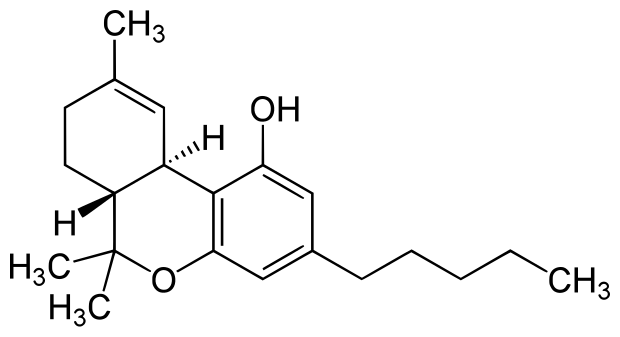
Chemists  were  just rolling up their sleeves to dig  deeper into the  plant concoctions to isolate more active ingredients, but alas  International Regulations and  Laws banned the    handling and use of psychotropic substances. Special pemissions had to be obtained to work on all narcotics. But  there  are those  who are not easily deterred.  And hence a few groups toiled on. Israeli chemist Mechoulam isolated the one and only  psychotropic ingredient in Cannabis,  Tetra Hydro Cannabinol (THC). It was indeed a huge morale boost for them when follow up studies by  neuro pharmacologists  showed  that  humans have built in receptors CB1 and CB2 specially reserved for Cannabinoids. That meant two things:   the human  body is  equipped  to receive cannabinoidlike chemicals and might actually be producing some ! Of these receptors  CB1 type is  found mostly in the central nervous system and CB2 in the immune system.   In  2014, a review appeared in the journal of American Academy of Neurology on the Efficacy and safety  of medical marijuana in selected neurologial disorders. . 
Cannabidiol(CBD) Courtesy: wikipedia

Tetra Hydro cannabinol(THC)
Courtesy: wikipedia


GW pharmaceuticals based in UK  holds permission for conducting research in cannabinoids. A mouthspray developed from whole cannabis extract is approved in several countries for treatment of spasticity in multiple sclerosis patients. Another  drug  for epilepsy will soon be in market.  

Reference 

1. Cannabis Outlook: Nature 24 September 2015.