Thursday, February 1, 2018

When pushed to the extreme


Freezing, arid  terrain with sweeping winds: that is Antarctica, the southernmost continent on Earth.   Since the sighting of the ice mass in the first half of the nineteenth century by marine explorers,  Antarctica has attracted umpteen   expeditions. During the second half of twentieth century  extensive aerial surveys of the continent  were conducted mostly by the United States. Airplanes    carrying scientists and radar equipments criss-crossed over the icy continent. From the radar data   thickness of the ice cover  and presence of liquid water below the sheet could be estimated.   While those  old maps provide information on what the terrain was like "Then",    modern satellite imaging techniques yield detailed   "Now" images.
Antarctica with ice shelves marked-Courtesy Wikipedia
   
United States' National Science Foundation funds several projects on various aspects of Antarctica. Project Midas undertaken by UK    focuses on stability of Larson C ice shelf in West Antarctican coast. In addition to these two countries several others have  permanent research stations  there.  

Limacina Helicina Courtesy: Wikipedia
Not only penguins, blue whales and krill, Antarctica accommodates life in many other forms.  The terrain as such  is hostile; with  global warming and consequential increase in the acidity of the ocean   would it become even more inhospitable?   Tiny marine snails, Limacina Helicina (also called sea butterflies because evolution equipped them with wings rather than feet) have already devised a counter measure. Acidic ocean can leach out the protective coating on their outer shell. They have learnt to repair this damage not by regenerating the coating but by thickening the innerside of the shell by appropriate secretions. In the picture alongside, the white rectangle marks  the area where the effect of ocean acidification was studied. The antarctic fish Emerald rockcod too has braced itself against warming and acidity of the ocean, although it can take on only one at a time. 
  

Prof. Belinda Ferrari from the Australian Centre for Astrobiology recently recorded the ability of certain microbial communities to "live  on air alone".  These microbes  belonging to phyla Actinobacteria, can survive by oxidising trace amounts of atmospheric hydrogen and carbon monoxide, present in the atmosphere. Detailed genetic and biochemical studies showed that the microbes possess three very important enzymes: high-affinity hydrogenases, to  catalyse the reversible oxidation of hydrogen, carbon monoxide dehydrogenases to  facilitate the conversion of carbon monoxide to carbon dioxide and  CO2 fixation enzymes of the  RuBisCO family to   "fix" inorganic carbon into organic carbon. 

 Tailpiece:
Antarctic tourist season is from November to March, the summertime in southern hemisphere. 2016-17 clocked more than 44,000 visitors!
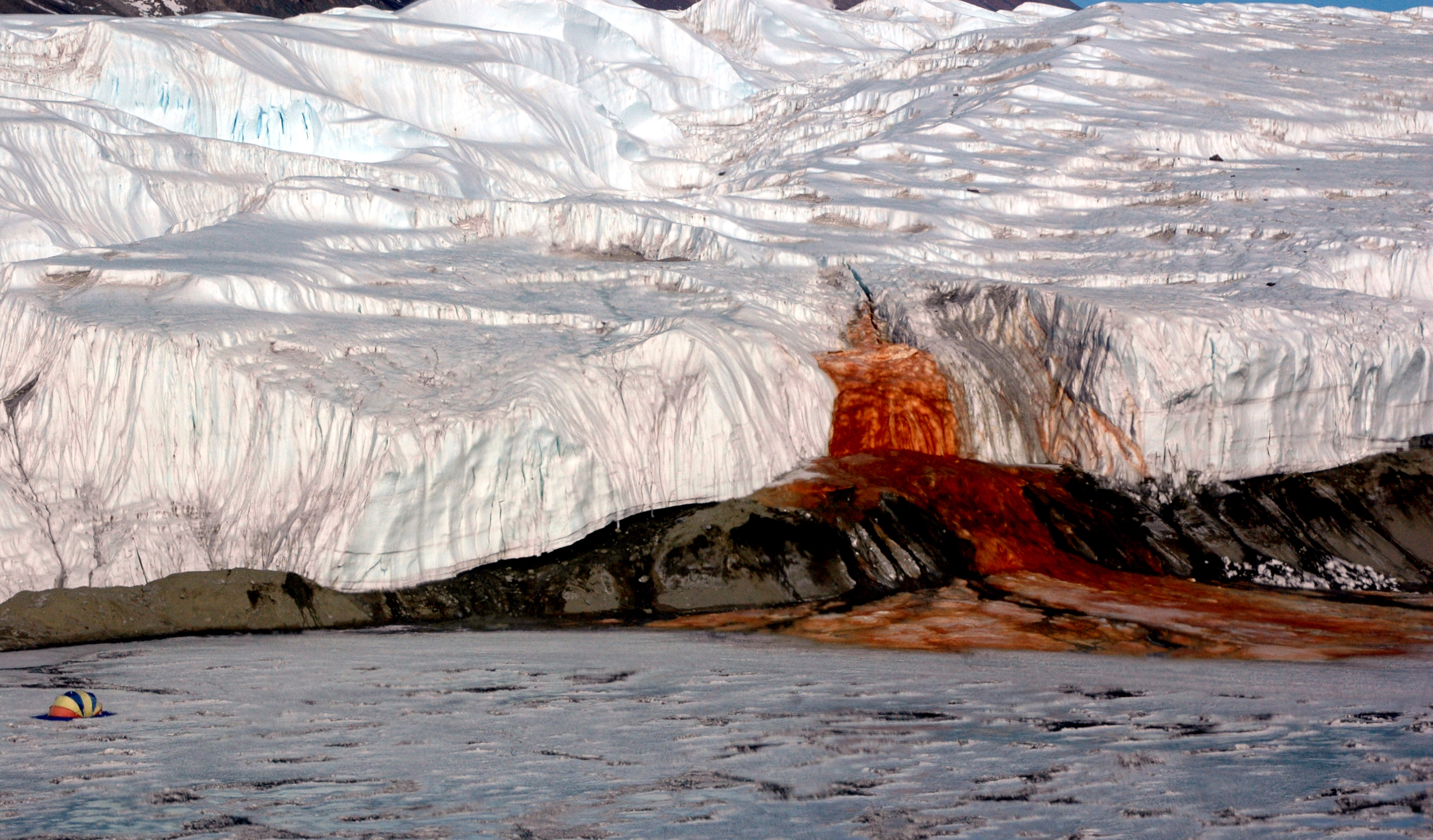
Blood Falls: Iron oxide stains the water flow
blood red in Taylor glacier
Courtesy:Wikipedia


References:
1. Flying lab to investigate Southern Ocean's appetite for carbon
2. Coping with climate stress in Antractica
3. Sea butterflies patch up shell damage from ocean acidification
4. Pteropods counter mechanical damage and dissolution through extensive shell repair
5. Scientists find antarctic microbes that live on air alone

Monday, January 15, 2018

Shocking Experiments!!!!


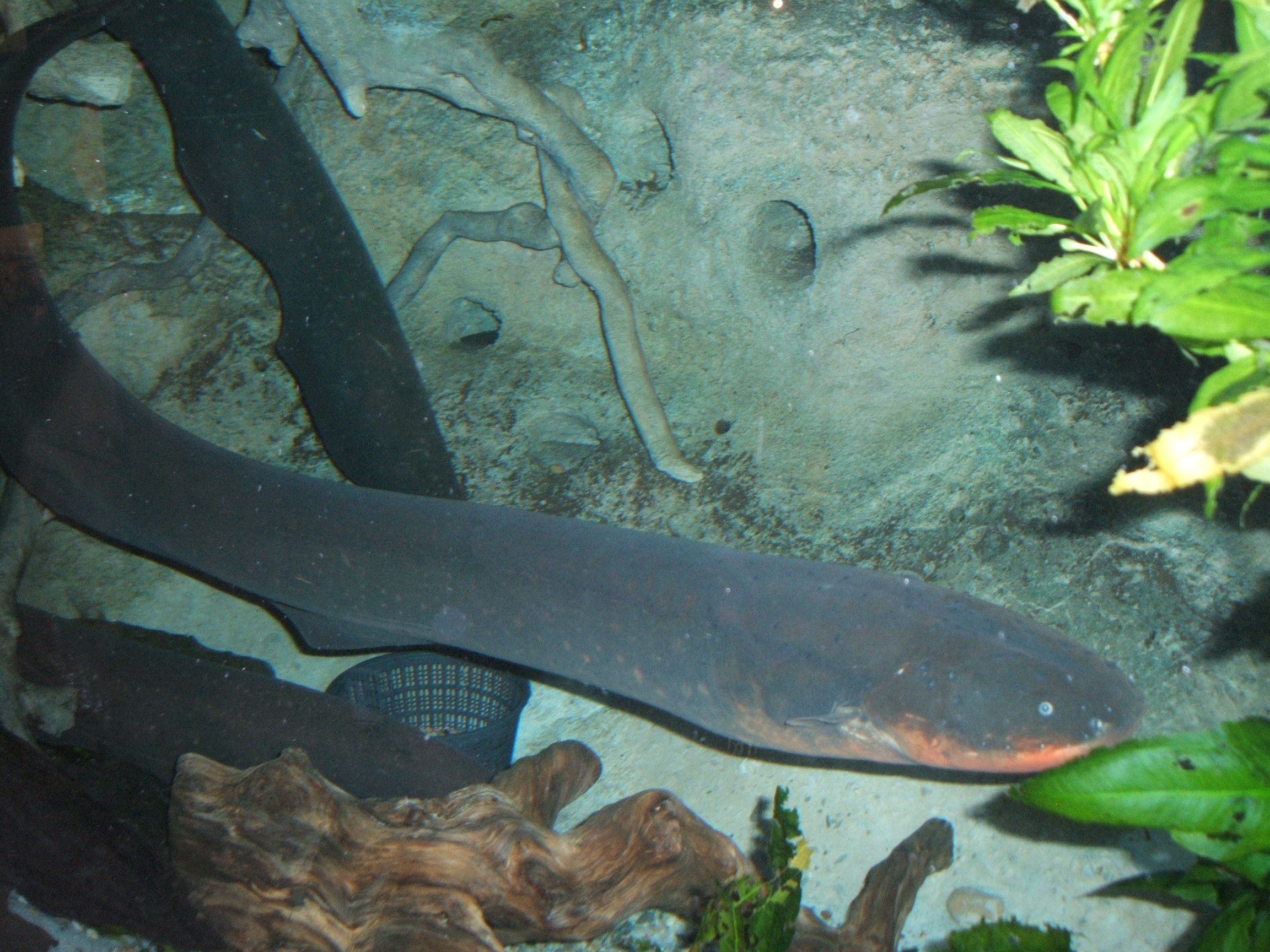
Professor Kenneth Catania is indeed a brave man. He let himself be stung by an electric eel ten times.  During this experiment  his arm remained  coupled with a  measuring device  so that  the intensity of the shock could be measured. In science one data point is inclusive and hence  10 times!.  After all repeatability and reproducibility are the hallmarks of Science.  All 'In the Name of Science' Washington Post commented. The research paper(see ref.2) appeared in the Sept. 25th(2017) issue of  Current Biology. Catania had selected a smal, juvenile  electric eel for the experiment, and  the mild shock of  about 40-50mAmp, generated acute short term pain, but no long-lasting injuries. An eel can deliver two types of shocks, low voltage when they are linear  and high voltage when they curl up. 
Electric Eel  Courtesy wikipedia

Major part of the eel's body, almost 80% is a powerhouse.  Electrocytes, the electricity producing cells are compacted in parallel stacks inside the electric organ. Neurotransmitter acetylcholine is the messenger  that signals the cells to  align and get activated. As Na+  K+ ion channels open and close in a synchronous fashion a voltage across the anterior and posterior membranes of the cell is developed.  Each cell contributes a tiny amount of electricity but when linked in series the output  adds up.  In an airborne attack, that is when the eel leaps out of water  the blow could be stunning.  
Voltage development across a cell membrane
courtesy: wikipedia


As described in Ref 4
The electric eel inspired Schroeder and colleagues too, but in a rather different way. They viewed the eel as the apt  model for designing and developing a biocompatible  " soft power source".  In many  medical applications the need for a soft pliable energy device  has long been felt.  Schroeder and his team set out to bridge that gap.  They selected  hydrogels as the basic material to design the electrocytes. Hydrogels are materials with 90% water and 10% biological or synthetic polymer. Their design is shown in the picture-   a cation selective gel, separated from an  anion selective gel with an intervening low salt gel and the whole assembly sandwiched between two high salt content  gels. In resting state gels are separated with no current flowing, but when they are brought into contact, ionic gradients result in voltage development.    This is just the beginning; Schroeder's team is hopeful that next generation devices  will  " open the door to metabolically sustained electrical energy powering implants, wearables and other mobile devices". 


References:

1 Biologists reaches into electric eel tank, comes out with equation to measure shocks 
2. Power transfer to a Human  during an Electric Eel's Shocking Leap
3. Watch an electric eel zap a biologist in the name of Science 
4. An electric eel inspired soft power source from stacked hydrogels.


Thursday, October 26, 2017

BodyNET: Sixth Sense in the Making

A new concept, On skin body area networks  abbreviated as bodyNET is all set to revolutionise the way we  communicate. In a  recent  report in Nature, researchers  Bryant Chu,   William Burnett, Jong Won Chung and  Zhenan Bao of the Stanford University     foresee not too distant a future when bodyNET will enable us "to sense and communicate with    others and the surroundings  in new and sophisticated ways beyond the  existing 5 senses".  In that context bodyNET will indeed function as the sixth sense.  Imagine  wearing your smart phone as a digital tattoo or a patch on your skin.   Exactly five years ago   a write up on medical tattoos ( Time for Medical Tattoos ) appeared here; now the umpteen possibilities of the concept are being explored.  


True; as of now  bodyNet is not yet ready, it is still in the developmental stage. Central to the design of bodyNET is the class of materials known as elastronics.  These are materials which can stretch like elastomers (rubber) and can be  embedded with the necessary electronics. The electronic circuits must be stretchable too in everywhich way without compromising on their performance. This indeed is the first challenge. Then follow the need for suitable sensors, energy sources etc.  There are additional requirements- of miniaturisation,  of biocompatibility (since the devices will be worn on skin or implanted), of durability  in  a variety of physiological and climatic conditions and above all cost.  Global demand for  such ensembles  is expected to peak by 2023.

Samsung Gears and Apple Watches are wearable smart devices  currently in the market. Team bodyNET has much more ambitious plans for their first generation product.   Subsequent  versions will have the capability to interact with  digital networks as well as decode physical and biological signals which are otherwise invisible.   But these capabilities also raise   uncomfortable  questions of privacy threats and data security. Chu et al are aware of these challenges and are confident that the necessary  legal checks and balances will also come into force in parallel. 

TAILPIECE:
On the flip side, if you opt for a decorative conspicuous patch, then you might  be displaying your moods for the whole world to see; permitting everyone into your personal space. 


REFERENCES:
1. Bring on the bodyNET
2. Global Stretchable electronics Market

Thursday, September 28, 2017

Herceptin- A case of Perseverance in Drug Development

From concept to commercialisation,  drug development takes decades.  The process demands a concerted, multi-disciplinary approach involving several agencies.  The time span is too long for   people and management  to remain committed to the cause. That almost happened to  Herceptin,  the best drug now available  in the market for HER2 positive  breast cancer.  Now in living tissues   HER-2 protein is the  biochemical signal for  cells to grow and multiply.   When the levels of   HER-2, become abnormally high, cells are  provoked  to  mushroom at an alarming rate and that is cancer. This type of cancer is also referred to  as HER2 positive.  Herceptin moieties  attach themselves to HER2 receptors and suppress them. The uniqueness of  herceptin  is that it doesn't have the debilitating side effects of either chemotherapy or radiotherapy. 

Herceptin,  has the generic name Trastuzumab which in WHO nomenclature is loaded with information. While Tras is a euphonic prefix,  tu stands for miscellaneous tumours, zu for   humanised and mab for   monoclonal antibody.  This drug was  developed jointly by  scientists at the biotech company  Genentech and the University of California,Los Angeles.  Axel Ullrich of Genentech and Dennis Slamon of UCLA were at the helm in the beginning. When Ullrich moved to Max Planck Institute of Biochemistry, it fell on Slamon to see the project through.  In retrospect, the timeline presents a hazzle free smooth roadmap, as easy as connecting the dots: for example  the seventies provided  the concept of monoclonal antibodies; by the eighties  the HER2 gene was cloned  and its role in   breast cancer  established; beginning of  nineties saw the  design and creation of herceptin and by 1998 the FDA approval was in place.  But it wasn't a smooth sail at all.  Science journalist Robert Bazell tells the story in great detail in  his book  Her-2 :The making of Herceptin, a revolutionary treatment for breast cancer. Scientific hurdles apart, there were parties with vested interests. 

New England Journal of Medicine in its review described the book  as  the story of the triumph of an inspired clinician against great opposition, which included his own colleagues, grant-awarding agencies, and pharmaceutical companies. Robin M. Henig , wrote      in    The New York Times     : Populated with single-minded scientists, clueless biotech company executives and women stricken with a particularly vicious form of breast cancer -- one that rages so fiercely that it can erupt along the fault lines of a mastectomy incision even before the scar heals -- ''Her-2'' is about the making and marketing of an entirely new kind of cancer therapy. 
Later the book was made into a telefilm " Living Proof" 

REFERENCES:
1. Genentech Her2 Story

2. HER-2: The making of Herceptin, a Revolutionary Treatment for  Breast cancer by Robert Bazell, Random House 1988 ISBN 13: 978-0812991840

Friday, September 1, 2017

Lights off please, let them work !

Time to time NASA releases images of Earth at night. These are  night maps of human activity.  In these snapshots  Mother Earth seems  like a diamond studded field.  Eastern US , Western Europe and Japan are the most glittering areas in the map with Africa remaining true to its name:  Dark Continent-  leading to   rather confusing trend  of equating a nation's development index to its energy consumption.  NASA's  nighttime images have multiple objectives- to collect  climatic & meteorological  data, to spot oceanic activities such as  unregulated fishing  and  of course they could serve as surveillance maps- monitor ing clandestine activities in war zones.  
Earth at Night  Courtesy NASA


But there are others who strongly believe that  such images  can be used as powerful tools to monitor Light Pollution and take necessary steps to protect  endangered and fragile ecosystems.  Light Pollution? Are we waking up to a new threat?   Not exactly. We have been unconsciously aware of this issue for quite some time now but didn't take it seriously. For example when did we last spot  the glow of fireflies in our garden?  Scientists have attempted to quantify the danger of depleting nocturnal visitors.  In a research  article published in the 10th August issue of Nature,  Eva Knop and coworkers alert us to the dangers of  ALAN (Artificial Light At Night).     Knop et al provide data on how ALAN  adversely affects the habitats of nocturnal species consequently how  their population has registered  a global decline. Nocturnal pollinators (insects and animals) are essential for sustaining Nature's biodiversity.   The research team is  apprehensive that dwindling   nocturnal pollinator population will eventually affect   the well-being of  diurnal pollinators too because  decreased pollen transport means reduced food availability. In their detailed study, which covered  14 wild meadows ( 7 test fields, and 7 controls), the team  monitored  interactions between flowers(plants)  and their nocturnal visitors. They recorded  that in illuminated fields,  nocturnal visitors  flocked towards the light source,  totally  neglecting the flowers with the result that  pollinator -flower contacts were  reduced by 62%.  

Several earlier studies highlight the issue and provide detailed  cost-benefit analyses of artificial nighttime  lighting on the environment. Perhaps for our part we could switch off our porch  and garden lights and thus encourage   fireflies to visit us.  But there a lurking dangers-  a house wrapped in darkness might attract burglers and thieves too. 

Tailpiece:
Day and Night is a 6 minute animated film (2010) in which an exuberant guy  Day, encounters  Night who is forever a gloomy.  The initial  intense dislike between them soon turns into a unique friendship when each realises that  that they are just two sides of the same coin. 

REFERENCES:
1. Artificial light at night as a new threat to pollination.Knop et al, Nature 548 p.206-9 2017

2. The dark side of street lighting : impacts on moths and  evidence for the disruption of 
    nocturnal pollen transport  Macgregor et al  Glob.Change Biol. 23, 697-707 2017

3. Ecological consequences of Artificial Night Lighting: edited by Catherine Rich and 
     Travis Longcore, Island Press 2013

Saturday, July 29, 2017

Our Rivers.....Dammed Everywhere !

  
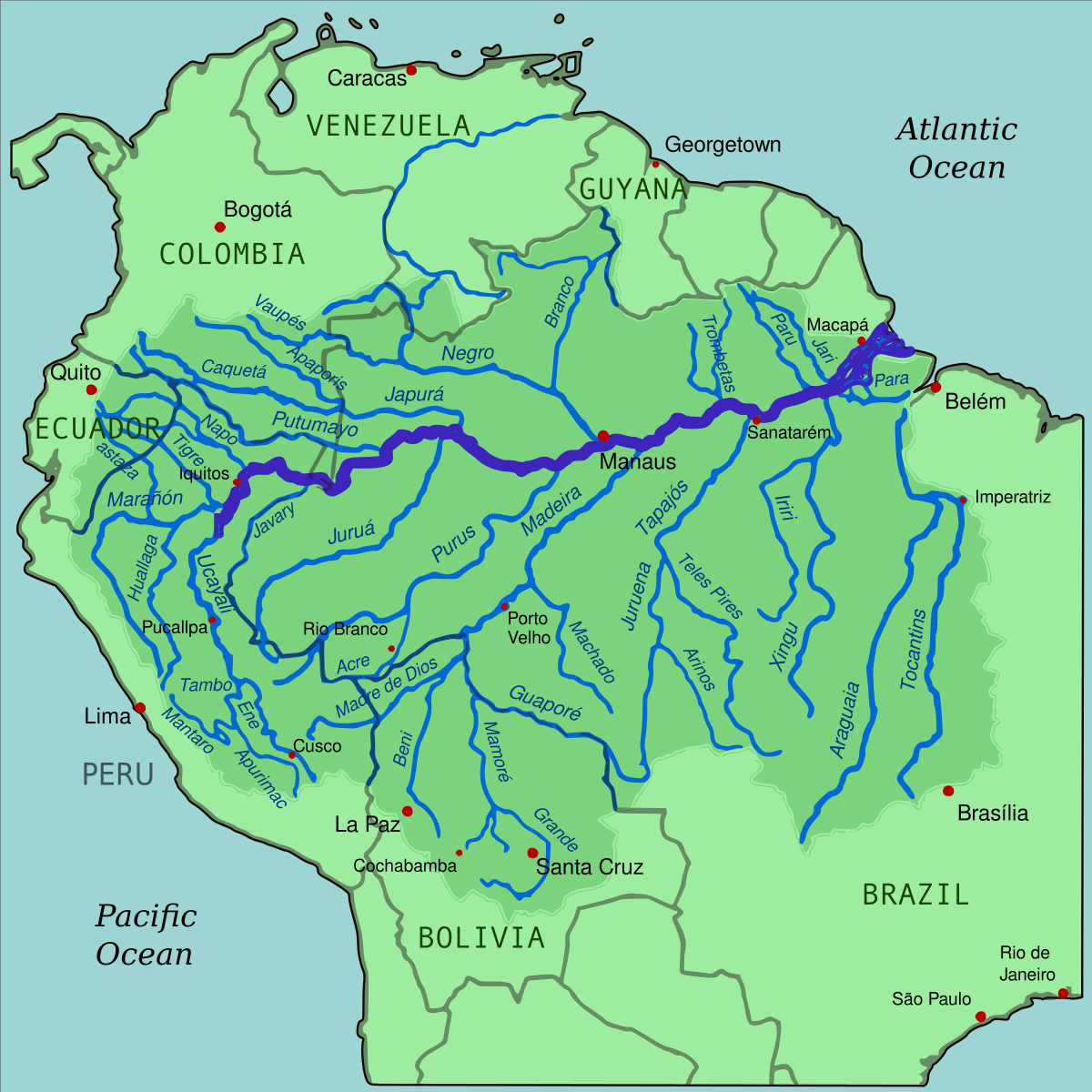
Amazonia -Amazon River and the drainage basin :
courtesy Wikipedia
This sums up  the state of almost all the  major rivers on Earth. Globally, dams, small and big are being built as a part of developmental agenda. However environmentalists have serious reservations. While developers  assert  with solid  numbers in terms of quantity  of water saved,  areas of farmland irrigated and gigawatts of  electricity generated,  environmentalists are often at a disadvantage because they don't have numbers to support their arguments. But it is indeed true  that  dam building exercises expose  river basins and the associated ecosystem to irreversible alterations which are often irreparable and or irremediable.  

In a recent issue of Nature Latrubesse and his team  ask and answer the crucial question: Can we  quantify  the effects of  dams on the ecosystem? They  focused on  the Amazon basin, its floodplains,  estuaries and the whole diverse ecosystem sustained by the mighty   Amazon and its tributaries. Amazonia, with its amazing biodiversity is an invaluable ecological marvel which  influences terrestrial climate. Evolved over  millions of years of geological history, Amazonian ecosystem is critical to the well being of mother Earth.   A total of 428 hydel projects (of which    roughly 140 are completed or in advanced stages of construction)  are planned along the rivers.  This means encroaching into Amazonina forests and eating into the pristine forest areas referred to as Intact Forest Landscapes(IFLs).   Hence it has become imperative that we assess the impact of dams  on  the Amazonian ecosystem but conduct similar studies  on all other major rivers.   Taking into consideration a multiplicity of  short term and long term effects Latrubusse and team calculate  Dam Environmental Vulnerability Index , abbreviated as DEVI to quantitatively assess the impact of  dams, both existing  and proposed  on the environment.  DEVI is a composite parameter which  includes Basin integrity Index, (BII), Fluvial Dynamics Index (FDI) and DII (Dam impact Index). What do each of these indices stand for? The team provides the following definitions: 

BII: Basin Integrity Index : quantifies  the vulnerability of the river basin to existing and potential changes in  land use , potential erosion and runoff pollution; 

FDI : Fluvial Dynamics Index :Gauges the influence of he fluxes of sediment transported by the rivers, the morphodynamic activity of the rivers, stage -range of the flood pulse;

DII: Dam Impact Index: quantifies how much of the river system will be affected by the planned and built dams. 

Latrubusse and coworkers feel that often the benefits of the mega hydel projects are  exaggerated  and the cost of environmental vulnerability undermined.  They and other likeminded scientists caution that indiscriminate  dam building projects could spell  recipe for sure disaster. 
TAILPIECE
Alas! The river has already been marginalised.   Web search for Amazon tosses up  links for  the online shopping giant, rather than for the river.    

References 
1. Damming the rivers of Amazon basin Latrubusse et al Nature 15 June 2017, Vol.546, pages 363-369
4. The Amazon basin in transition Davidson et al Nature 19 January 2012, vol. 481, pages 321-328
5. Balancing hydropower and biodiversity in the Amazon, Congo and Mekong  Windmill et al Science 8 January 2016, 128-129


Friday, June 30, 2017

The other side is getting greener

President Trump's declaration that the USA would pull out of the Paris Climate  Agreement has sent across waves of disappointment. The agreement was a collective , ambitious   commitment to to keep global warming well below 2 deg.Celsius. 

As  early as 1861 Tyndall, professor of Physics at the Royal Institute  detected how human activities could  influence atmospheric temperature. A hundred years later Manabe and colleagues  provided a rigorous   quantitative platform. Piers Forster at the School of Earth and Environment, University of Leeds,U.K  highlights the significance of Manabe’s research work. Watanabe’s group built robust models of climatic change. To quote from his website  Earth’s climate has fluctuated greatly during the geological past. Throughout my career, past climate changes have posed many challenging questions, which we have tried to answer using climate models with various complexity.”

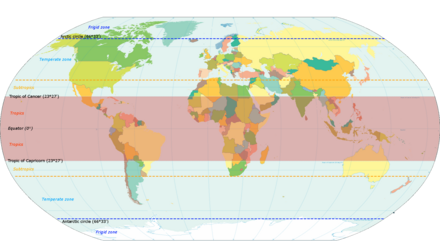
Aron Putnam at the  School of Earth and Climate Sciences & Climate Change Institute University of Maine together with Wallace Broecker  faculty at the Earth & Environmental sciences at  the Columbia University  studied the rainfall pattern.  This is what they say: The first possibility is that rainfall in the tropics will increase  and  the subtropics and mid latitudes will become more arid.  A second possibility is that Earth’s thermal equator , around which the planets’s rain belts and dry zones are organised , will migrate northward. This northward shift will be a consequence of the Northern Hemisphere , with its large continental area , warming faster than the Southern Hemisphere, with its large oceanic area. A third possibility is that both of these scenarios will play out simultaneously.


Tropical zone highlighted in pink Courtesy: wikipedia  KVDP's Own work. 


TAILPIECE

While we are busy  with models and predictions, Mother Nature is quietly at work.  Though  most of Antarctica is snow covered uninhabitable place,  of late it has been turning green with a crop of moss. Amesbury and colleagues at the University of Exeter observe that the Antarctican  ground is  getting greener for the past 50 years. It looks like  as the north gets increasingly uninhabitable, there  will be a southward human migration eventually 

REFERENCES:
 1. Tyndal,J:  On the absorption and radiation of heat by gases and vapours. Philos. Mag. 22: 169–194 and 273–285
2. Forster, P: Half a century of robust climate models  Nature 545, 296-7 (2017) 
3.Manabe & Stricker : Thermal equilibtium of the atmosphere with a convective adjustment 21, 361-385 4.Manabe & Wehterald :  Thermal equilibrium of the atmosphere with a relative distribution of humidity  J. Atmospheric sciences  1967 24(3) 241-259 
5. Putnam & Broecker Human induced changes in the distribution of rainfall Science Advances  31 May , 2017 
6. Amesbury et al  Widespread biological response to rapid warming on the Antarctic peninsula, Curr Biol27(11), 1616-1622